HVAC Field Service Management Software: From First Call to Final Invoice
The HVAC service call has more operational moving parts than almost any other trade. It begins with an urgent customer call, often during a heat wave or cold snap when you are already handling triple your normal call volume. It requires dispatching the right technician—one who holds the appropriate refrigerant handling certifications and has the likely parts on their truck. It demands a precise, documented diagnostic process that both satisfies the customer and protects you legally. And it must conclude with a professional invoice collected on the spot, because HVAC customers expect to pay at the point of service.
Attempting to execute this complex workflow without purpose-built technology is like trying to run a commercial kitchen without a ticket system—possible in theory, catastrophic in practice at any real volume. HVAC field service management software is the operational backbone that makes it possible to handle 50 service calls a day without losing a single order, missing a single customer commitment, or letting a single invoice slip through the cracks.
The HVAC Service Lifecycle: A Software-Enabled Walkthrough
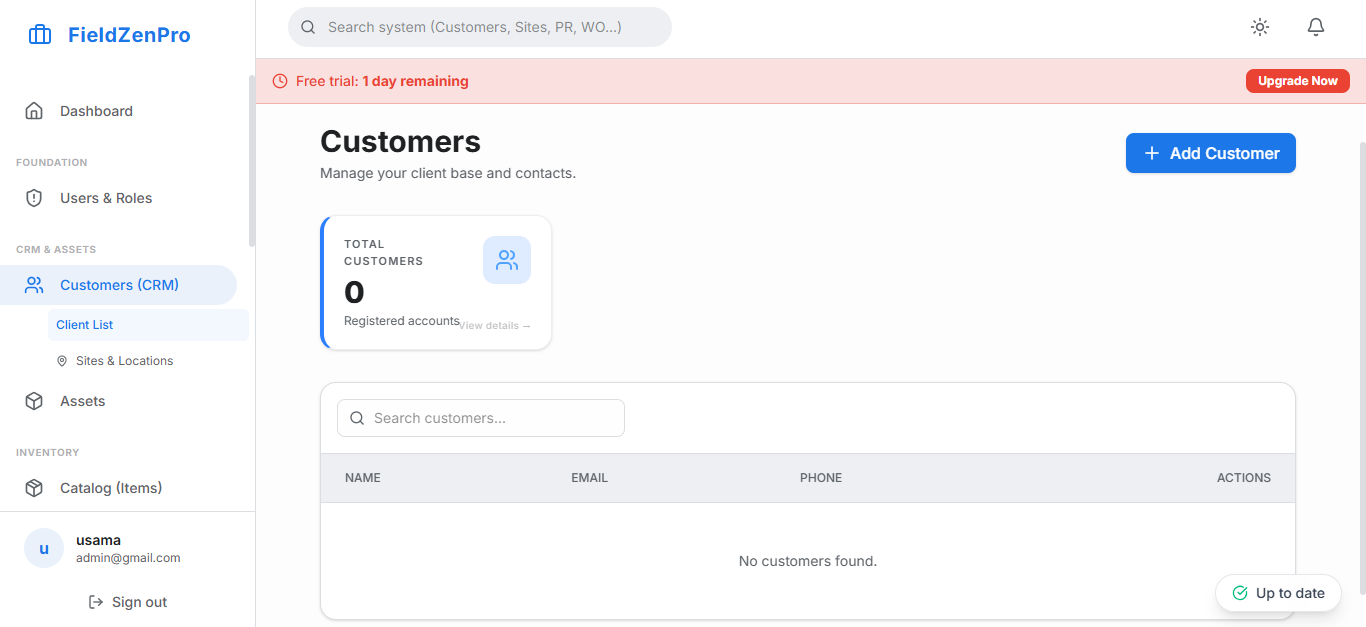
The best way to understand the value of HVAC field service management software is to walk through a complete service event from first call to final payment, comparing the paper-based and software-enabled experiences side by side.
Stage 1: The Incoming Call
Without software: The dispatcher answers the call, scribbles the customer's name, address, and complaint on a notepad, and promises to "have someone there as soon as possible."
With software: As the phone rings, the customer's full profile populates on the dispatcher's screen—address, all equipment on file, last service date, and any outstanding quotes. The dispatcher greets them by name with full context. As they describe the problem, the dispatcher enters it directly into a new job card. By the end of the call, a digital work order is already created and the customer has received a text message confirming their appointment.
Stage 2: Intelligent Dispatch
Without software: The dispatcher calls three technicians to find out where they are. The first two don't answer. The third is 40 minutes away but agrees to go.
With software: The dispatcher looks at the live GPS map and instantly sees that Technician Marcus is 8 minutes away, currently finishing a job that the system shows will be complete in 12 minutes. The dispatcher assigns the job to Marcus with one click. Marcus's phone vibrates with the new job notification, complete with the customer address, equipment notes, and the reported symptom ("AC blowing warm, ran all night").
"The gap between HVAC companies that dominate their market and those that struggle is rarely technical skill—it is operational infrastructure. Software is the infrastructure."
Stage 3: The Field Diagnosis
Marcus arrives and opens the job on his tablet. He can see that this customer had the same unit serviced 14 months ago, and the previous technician noted "refrigerant slightly low, monitor." Marcus knows immediately what to check first. After diagnosing a slow refrigerant leak at a Schrader valve and a slightly dirty evaporator coil, he opens the quoting module. He builds a "Good, Better, Best" proposal:
- Good: Repair the Schrader valve and recharge refrigerant — $389
- Better: All of the above + coil cleaning — $549
- Best: All of the above + annual maintenance agreement enrollment — $749
The customer reviews the options on the tablet, appreciates the transparency, and chooses "Better." She signs her approval on the glass. Marcus gets to work.
Stage 4: Parts, Inventory, and Documentation
Marcus logs the refrigerant used from his truck directly into the mobile app, which deducts it from his truck's inventory. He takes "before" photos of the dirty coil and the leaking valve, and "after" photos of the clean coil and repaired valve. He adds field notes about the recommended timeline for the next tune-up. Every action is timestamped and tied to his employee profile, creating a complete, auditable service record.
Stage 5: Invoice and Payment
The customer is delighted. Marcus taps "Complete Job" in the app. A professional, branded invoice is generated instantly, incorporating the digital work order, the signed quote, and the itemized parts and labor. The customer taps her credit card on Marcus's Bluetooth reader. Payment is processed in 8 seconds. The invoice receipt is emailed automatically. Marcus is in his truck and heading to his next job within five minutes of finishing the repair.
The Annual Maintenance Contract Engine
The example above illustrates reactive service. But the highest-margin revenue in HVAC comes from proactive, recurring annual maintenance agreements. Great HVAC field service management software automates the entire contract lifecycle: auto-generating spring and fall tune-up work orders, sending renewal notifications 45 days before expiration, and tracking contract coverage rates by neighborhood and property type so you can identify the most profitable areas for targeted marketing campaigns.
Run Your HVAC Business at Maximum Efficiency with FieldZenPro
FieldZenPro was purpose-built for HVAC service operations. Every feature—from refrigerant tracking to "Good, Better, Best" quoting to automated maintenance contract management—was designed with the specific rhythms of heating and cooling service in mind.
Related Articles & Resources
Master the HVAC Service Lifecycle
From emergency dispatch to maintenance contract renewal—manage it all with FieldZenPro.
Start Your 14-Day Free Trial