Field Service Management Tools: Build Your Complete Operational Toolkit
Every trade professional has a toolbox. A master electrician's toolbox contains every instrument they need to diagnose, install, and repair—multi-meters, wire strippers, circuit testers—each serving a specific, essential purpose. The collection of these tools, organized and accessible, is what allows them to handle any situation they encounter in the field.
Running a service business requires an equally well-curated digital toolbox. The field service management tools in this toolkit are the software capabilities that collectively allow your business to handle any operational situation—from a routine maintenance call to a complex emergency dispatch cascade—efficiently, professionally, and profitably.
In this article, we catalogue every essential tool in the modern FSM toolkit, explain what each one does, and show how they work in concert to create an operation greater than the sum of its parts.
The Essential FSM Toolkit: 10 Must-Have Tools
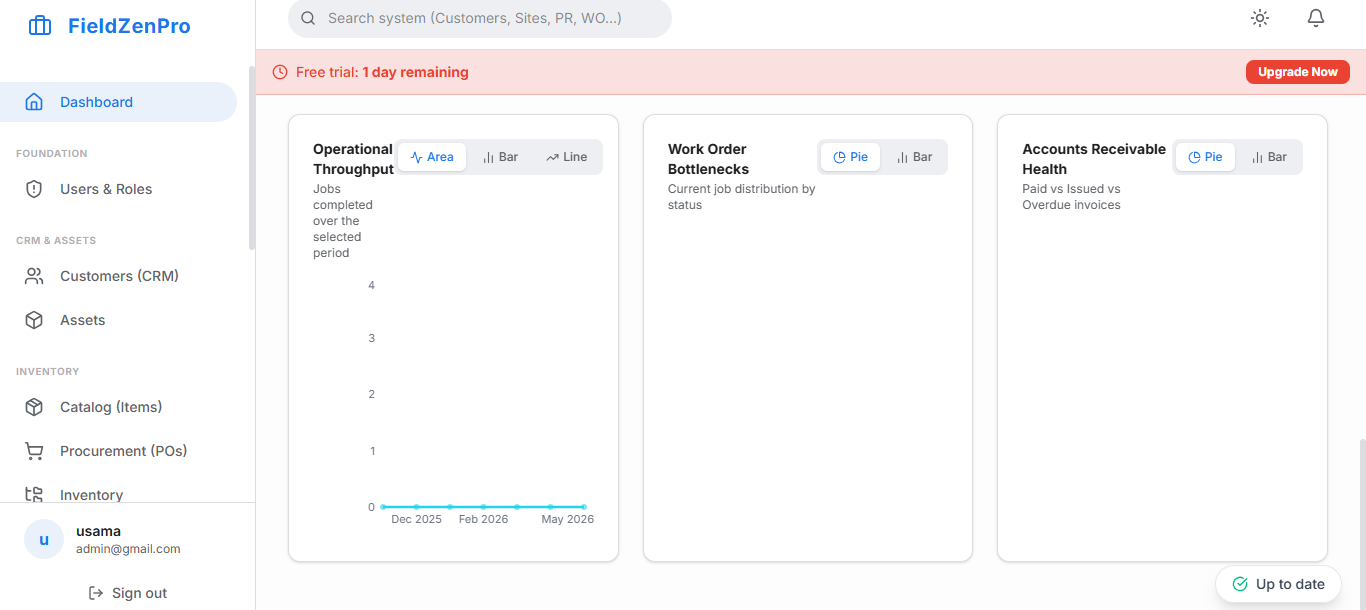
Tool 1: Dynamic Dispatch Board
The command center of your operation. A great dispatch board gives your team a real-time, map-based view of all active technicians and outstanding jobs. It supports drag-and-drop job assignment, live GPS technician tracking, color-coded job status indicators, and automatic drive-time calculation. Without this tool, dispatching is a phone-tag exercise. With it, dispatching becomes a strategic, visual operation.
Tool 2: Offline-First Mobile App
The technician's primary interface for every job. It must display job details, enable digital quoting, capture photos, support e-signatures, process payments, and update job status—all without requiring internet connectivity. This is the tool that generates all field data, so its reliability and usability directly determines the quality of every other data-dependent tool in the system.
Tool 3: Customer and Equipment CRM
The memory of your business. A dedicated CRM stores every customer's contact information, all service locations, every piece of equipment ever serviced (with full technical specs), and the complete history of every interaction. This institutional memory is what allows a technician who has never met a customer to arrive at their property feeling like an old friend who knows their system intimately.
Tool 4: Digital Quoting Engine
The revenue accelerator. A great quoting tool allows technicians to build professional "Good, Better, Best" proposals in the field, with high-quality images and detailed descriptions for each option. Presenting options visually on a tablet increases average ticket size by 20–35% compared to verbal or handwritten quotes. The best quoting engines include electronic signature capture and automatic conversion to an invoice upon approval.
Tool 5: Smart Inventory Management
The parts tracker. Real-time visibility into which parts are in the warehouse, which are on each truck, and which are on order eliminates two of the most expensive operational failures: return trips to the supply house (costing fuel, time, and customer patience) and parts that are used but not billed (a common source of gross margin erosion).
"Your field service management toolkit is only as strong as its weakest tool. A single broken link—a mobile app that fails offline, an inventory system that isn't real-time—can cascade into systemic operational failures."
Tool 6: Automated Customer Communication Suite
The relationship manager. Automated confirmation emails, reminder SMS, "en route" notifications, post-job review requests, and contract renewal reminders—all firing without any manual dispatcher action. This tool handles the communication workload of a full-time customer service agent at a fraction of the cost, while delivering more consistent and timely messaging than any human team could provide.
Tool 7: Digital Invoicing and Payment Processing
The cash flow engine. Invoices generated the moment a job is complete, emailed automatically, and payable via credit card, ACH, or financing options—collected at the job site or online within hours. This tool eliminates the invoice delivery lag and dramatically accelerates your average collection cycle from weeks to days.
Tool 8: GPS Tracking and Route Optimization
The efficiency multiplier. Live GPS tracking gives you real-time visibility into your fleet's positions and movement patterns. Route optimization algorithms cluster jobs geographically and calculate the most fuel-efficient daily sequences. Together, these tools reduce fleet operating costs by 15–25% and create capacity for additional billable jobs each day.
Tool 9: Reporting and Business Intelligence Dashboard
The strategic compass. Real-time dashboards displaying revenue per technician, first-time fix rates, customer satisfaction scores, and gross margin by service type. This tool transforms raw operational data into actionable business intelligence, giving owners and managers the visibility to make strategic decisions based on facts rather than intuition.
Tool 10: Workflow Automation Engine
The force multiplier. A no-code automation engine that allows you to configure "if this, then that" business rules: if a job is completed, generate an invoice; if an invoice is unpaid after 7 days, send a reminder email; if a maintenance contract is 30 days from expiry, generate a renewal task. Each automation removes a repetitive manual task from your team's workload permanently.
The Power of Integration: Tools That Work Together
The full value of these tools is only realized when they operate as a unified system. When the quoting tool is integrated with the inventory tool, quotes automatically deduct parts from available stock when approved. When the dispatch tool is integrated with the GPS tool, dispatchers can see route efficiency in real time. When the invoicing tool is integrated with the accounting tool, revenue is recognized automatically without manual bookkeeping.
Get the Complete Toolkit with FieldZenPro
FieldZenPro provides all ten essential field service management tools as native, deeply integrated capabilities within a single platform. There are no additional modules to purchase, no third-party integrations to configure, and no data silos to bridge. Your entire operational toolkit, unified and working in concert from day one.
Related Articles & Resources
Complete Your Digital Toolbox
Get all 10 essential FSM tools in one unified platform. Try FieldZenPro free for 14 days.
Start Your 14-Day Free Trial