Enterprise Field Service Management Software: Scale Without Losing Control
There is a critical difference between being a large service company and being an enterprise service organization. A large company has many technicians doing the same job they've always done, just at higher volume. An enterprise organization has engineered its operations so that quality, efficiency, and profitability are institutionalized—baked into processes and systems so that no single person's departure can disrupt the machine.
The platform that enables this institutional engineering is enterprise field service management software. It is categorically different from the SMB tools that work well for 5 to 20 truck fleets. Enterprise FSM software is architected for multi-branch operations, complex compliance requirements, advanced analytics, and API-driven integration with corporate ERP systems like SAP and Oracle.
In this article, we explore the defining characteristics of enterprise-grade FSM, the organizational signals that indicate you are ready for it, and how to select a platform that delivers genuine enterprise capability without an 18-month implementation nightmare.
What Makes Field Service Management "Enterprise-Grade"?
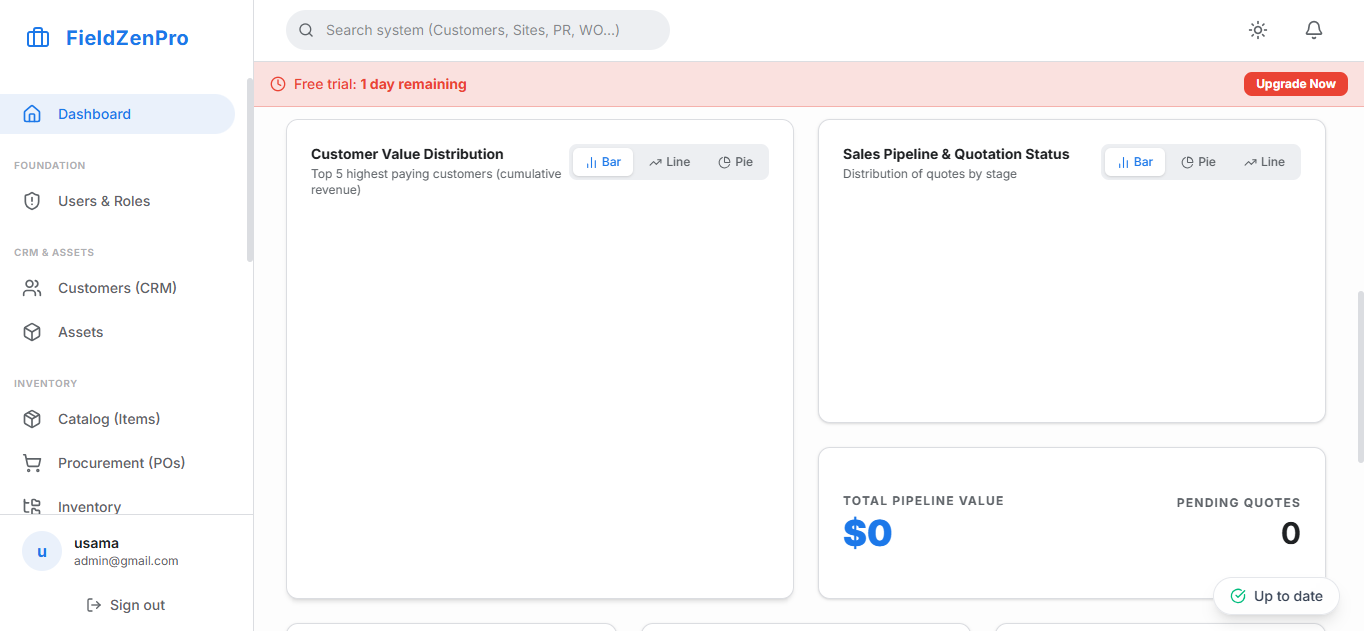
The enterprise designation is not merely a marketing label. It corresponds to a specific set of architectural and functional capabilities that are genuinely absent from SMB-focused platforms:
1. Multi-Branch and Multi-Region Operations
Enterprise service companies typically operate across multiple geographic regions, each with its own local workforce, inventory, and customer base. Enterprise FSM software provides a unified headquarters dashboard with the ability to drill down into individual branch performance. Corporate leadership can see consolidated revenue, first-time fix rates, and customer satisfaction scores across the entire organization, while regional managers see only their branch's operations.
2. Role-Based Access Control
When hundreds of employees interact with a single platform, controlling what each person can see and do is critical for both security and operational integrity. Enterprise FSM software provides granular, role-based access control. A field technician can see their own jobs but not financial reports. A branch manager can see their region's P&L but not another branch's customer data. A corporate administrator has global view with the ability to configure system-wide settings.
3. Enterprise Integration via APIs
Large organizations do not replace their entire technology stack when they add a new FSM platform. They integrate it. Enterprise FSM software provides documented, robust REST APIs that allow bi-directional data exchange with corporate ERP systems, HR platforms, CRM tools, and business intelligence systems. A completed job in the FSM should automatically trigger revenue recognition in the ERP. A new employee in the HR system should automatically appear in the FSM as an assignable resource.
4. Advanced SLA Management and Compliance
Enterprise service contracts frequently include SLA (Service Level Agreement) clauses with financial penalties for missed response times. Enterprise FSM software tracks SLA compliance in real time, alerting dispatch management when a job is approaching its SLA deadline. It also generates compliance reports that document SLA performance across all contracts—critical evidence if a customer ever disputes a penalty charge.
"Enterprise FSM software is not about adding features—it is about institutionalizing operational excellence across hundreds of employees and thousands of jobs per day."
5. Predictive Analytics and AI-Driven Scheduling
At enterprise scale, the volume of operational data creates an opportunity for genuine machine learning. Enterprise FSM platforms can analyze historical job data to predict which customers are at risk of churning, which equipment is approaching failure (enabling proactive maintenance outreach), and which scheduling patterns maximize technician utilization across the fleet. These predictions translate directly into higher revenue and lower costs at scale.
The Hidden Cost of Premature Enterprise Software
A word of caution: many growing mid-market companies rush into enterprise FSM platforms before their organization is truly ready. The resulting implementation failures are both expensive and demoralizing. Enterprise software requires dedicated internal resources to manage the implementation, a high level of process maturity to configure correctly, and ongoing technical support to maintain integrations.
If your organization does not have a dedicated IT function, defined and documented workflows for all service scenarios, and executive sponsorship for the implementation project, you will likely be better served by a premium SMB platform that can scale with you until you are ready.
FieldZenPro: Enterprise Power, Modern Architecture
FieldZenPro occupies the intersection of enterprise capability and modern SaaS usability. Our platform supports multi-branch operations, role-based access control, and open APIs for enterprise integrations, while maintaining the clean, intuitive interface that drives technician adoption. We serve organizations from 20 to 200+ technicians with a single, continuously updated codebase.
Related Articles & Resources
Scale With Confidence
Get enterprise-grade field service management with the speed and simplicity of modern SaaS. Try FieldZenPro free.
Start Your 14-Day Free Trial